Why do I really, really love West African languages?

So I found a wonderful free app that lets you learn Yoruba, or at least Yoruba words,  and posted about it on Google plus. Someone asked a very good question: why am I interested in Yoruba? Well, I’m not interested just in Yoruba. In fact, I would love to learn pretty much any western African language or, to be a little more precise, any Niger-Congo language.

Niger-Congo-en
This map’s color choices make it look like a chocolate-covered ice cream cone.
Why? Well, not to put too fine a point on it, I’ve got a huge language crush on them. Whoa there, you might be thinking, you’re a linguist. You’re not supposed to make value judgments on languages. Isn’t there like a linguist code of ethics or something? Well, not really, but you are right. Linguists don’t usually make value judgments on languages. That doesn’t mean we can’t play favorites!  And West African languages are my favorites. Why? Because they’re really phonologically and phonetically interesting. I find the sounds and sound systems of these languages rich and full of fascinating effects and processes. Since that’s what I study within linguistics, it makes sense that that’s a quality I really admire in a language.

What are a few examples of Niger-Congo sound systems that are just mind blowing? I’m glad you asked.

  • Yoruba: Yoruba has twelve vowels. Seven of them are pretty common (we have all but one in American English) but if you say four of them nasally, they’re different vowels. And if you say a nasal vowel when you’re not supposed to, it’ll change the entire meaning of a word. Plus? They don’t have a ‘p’ or an ‘n’ sound. That is crazy sauce! Those are some of the most widely-used sounds in human language. And Yoruba has a complex tone system as well. You probably have some idea of the level of complexity that can add to a sound system if you’ve ever studied Mandarin, or another East Asian language. Seriously, their sound system makes English look childishly simplistic.
  • Akan: There are several different dialects of Akan, so I’ll just stick to talking about Asante, which is the one used in universities and for official business. It’s got a crazy consonant system. Remember how  Yoruba didn’t have an “n” sound? Yeah, in Akan they have nine. To an English speaker they all  pretty much sound the same, but if you grew up speaking Akan you’d be able to tell the difference easily. Plus, most sounds other than “p”, “b”, “f” or “m” can be made while rounding the lips (linguists call this “labialized” and are completely different sounds). They’ve also got a vowel harmony system, which means you can’t have vowels later in a word that are completely different from vowels earlier in the word. Oh, yeah, and tones and a vowel nasalization distinction and some really cool tone terracing. I know, right? It’s like being a kid in a candy store.

But how did these language get so cool? Well, there’s some evidence that these languages have really robust and complex sound systems because the people speaking them never underwent large-scale migration to another Continent. (Obviously, I can’t ignore the effects of colonialism or the slave trade, but it’s still pretty robust.) Which is not to say that, say, Native American languages don’t have awesome sound systems; just just tend to be slightly smaller on average.

Now that you know how kick-ass these languages, I’m sure you’re chomping at the bit to hear some of them. Your wish is my command; here’s a song in Twi (a dialect of Akan) from one of my all-time-favorite musicians: Sarkodie. (He’s making fun of Ghanaian emigrants who forget their roots. Does it get any better than biting social commentary set to a sick beat?)

Ask vs. Aks: Let me axe you a question

Do you know which one of these forms is the correct one? You sure about that?

Four things are inevitable: death, taxes, the eventual heat-death of the universe, and language change. All (living) languages are constantly in a state of flux, at all levels of the linguistic system. Meanings change, new structures come into being and old ones die out, words are born and die and pronunciations change. And no one, it seems, is happy about it. New linguistic forms tend to be the source of endless vitriol and argument, and language users love constructing rules that have more to do with social norms than linguistic reality. Rules that linguists create, which attempt to model the way language is used, are called “descriptive”, while rules that non-linguists create, which attempt to suggest how they believe language should be used, are called “prescriptive”. I’m not going to talk that much more about it here; if you’re interested, Language Log and Language Hippie both discuss the issue at length. The reason that I bring this up is that prescriptive rules tend to favor older forms. (An occasionally forms from other languages. That whole “don’t split an infinitive” thing? Based on Latin. English speakers have been happily splitting infinitives since the 13th century, and I imagine we’ll continue to boldly split them for centuries to come.) There is, however, one glaring exception: the whole [ask] vs. [aks] debate.

Axt zum spalten
In a way, it’s kinda like Theseus’ paradox or Abe Lincoln’s axe. If you replace all the sounds in a word one by one, it is the same word at the end of the process as it was in the beginning?
Historically, it’s [aks], the homophone of the chopping tool pictured above, that has precedence. Let’s take a look at the Oxford English Dictionary’s take on the history of the word, shall we?

The original long á gave regularly the Middle English (Kentish) ōxi ; but elsewhere was shortened before the two consonants, giving Middle English a , and, in some dialects, e . The result of these vowel changes, and of the Old English metathesis asc- , acs- , was that Middle English had the types ōx , ax , ex , ask , esk , ash , esh , ass , ess . The true representative of the orig. áscian was the s.w. and w.midl. ash , esh , also written esse (compare æsce ash n.1, wæsc(e)an wash n.), now quite lost. Acsian, axian, survived inax, down to nearly 1600 the regular literary form, and still used everywhere in midl. and southern dialects, though supplanted in standard English by ask, originally the northern form. Already in 15th cent. the latter was reduced dialectally to asse, past tense ast, still current dialectally.*

So, [aks] was the regular literary form (i.e. the one you would have been taught to say in school if you were lucky enough to have gone to school) until the 1600 or so? Ok, so, if older forms are better, than that should be the “right” one. Right? Well, let’s see what Urban Dictionary has to say on the matter, since that tends to be a  pretty good litmus test of language attitudes.

“What retards say when they don’t know how to pronounce the word ask.” — User marcotte on Urban Dictionary, top definition

Oh. Sorry, Chaucer, but I’m going to have to inform you that you were a retard who didn’t know how to pronounce the word ask. Let’s unpack what’s going on here a little bit, shall we? There’s clearly a disconnect between the linguistic facts and language attitudes.

  • Facts: these two forms have both existed for centuries, and [aks] was considered the “correct” form for much of that time.
  • Language attitude: [aks] is not only “wrong”, it reflects negatively on those people who use it, making them sound less intelligent and less educated.

This is probably (at least in America) tangled in with the fact that [aks] is a marker of African American English. Even within the African American community, the form is stigmatized. Oprah, for example, who often uses markers of African American English (especially when speaking with other African Americans) almost never uses [aks] for [ask]. So the idea that [aks] is the wrong form and that [ask] is correct is based on a social construction of how an intelligent, educated individual should speak. It has nothing to do with the linguistic qualities of the word itself. (For a really interesting discussion of how knowledge of linguistic forms is acquired by children and the relationship between that and animated films, see Lippi-Green’s chapter “Teaching children to discriminate” from English with an Accent: Language  ideology and discrimination in the United States here.)

Now, the interesting thing about these forms is that they both have phonological pressures pushing English speakers towards using them. That’s because [s] has a special place in English phonotactics. In general, you want the sounds that are the most sonorant nearer the center of a syllable. And [s] is more sonorant than [k], so it seems like [ask] should be the favored form. But, like I said, [s] is special. In “special”, for example, it comes at the very beginning of the word, before the less-sonorant [p]. And all the really long syllables in English, like “strengths”, have [s] on the end. So the special status of [s] seems to favor [aks]. The fact that each form can be modeled perfectly well based on our knowledge of the way English words are formed helps to explain why both forms continue to be actively used, even centuries after they emerged. And, who knows? We might decide that [aks] is the “correct” form again in another hundred years or so. Try and keep that in mind the next time you talk about the right and wrong ways to say something.

* “ask, v.”. OED Online. December 2012. Oxford University Press. 12 February 2013 <http://www.oed.com.offcampus.lib.washington.edu/view/Entry/11507&gt;.

How to pronounce the “th” sound in English

Or, as I like to call it, hunting the wild Eth and Thorn (which are old letters that can be difficult to typesest), because back in the day, English had the two distinct “th” sounds represented differently in their writing system. There was one where you vibrated your vocal folds (that’s called ‘voiced’) which was written as “ð” and one where you didn’t (unvoiced) which was written as “þ”. It’s a bit like the difference between “s” and “z” in English today. Try it: you can say both “s” and “z” without moving your tongue a millimeter. Unfortunately, while the voiced and voiceless “th” sounds remain distinct, they’re now represented by the same “th” sequence. The difference between “thy” and “thigh”, for example, is the first sound, but the spelling doesn’t reflect that. (Yet another example of why English orthography is horrible.)

Used with permission from the How To Be British Collection copyright LGP, click picture for website.

The fact that they’re written with the same letters even though they’re different sounds is only part of why they’re so hard to master. (That goes for native English speakers as well as those who are learning it as their second language: it’s one of the last sounds children learn.). The other part is that they’re relatively rare across languages. Standard Arabic  Greek, some varieties of Spanish, Welsh and a smattering of other languages have them.  If you happen to have a native language that doesn’ t have it, though, it’s tough to hear and harder to say. Don’t worry, though, linguistics can help!

I’m afraid the cartoon above may accurately express the difficulty of  producing the “th” for non-native speakers of English, but the technique is somewhat questionable. So, the fancy technical term for the “th” sounds are the interdental fricatives.  Why? Because there are two parts to making it. The first is the place of articulation, which means where you put your tongue. In this case, as you can probably guess (“inter-” between and “-dental” teeth), it goes in between your teeth. Gently!

The important thing about your tongue placement is that your tongue tip needs to be pressed lightly against the bottom of your top teeth. You need to create a small space to push air thorough, small enough that it makes a hissing sound as it escapes. That’s the “fricative” part. Fricatives are sounds where you force air through a small space and the air molecules start jostling each other and make a high-frequency hissing noise. Now, it won’t be as loud when you’re forcing air between your upper teeth and tongue as it is, for example, when you’re making an “s”, but it should still be noticeable.

So, to review, put the tip of  your tongue against the bottom of your top teeth. Blow air through the thin space between your tongue and your teeth so that it creates a (not very loud) hissing  sound. Now try voicing the sound (vibrating  your vocal folds) as you do so. That’s it! You’ve got both of the English “th” sounds down.

If you’d like some more help, I really like this video, and it has some super-cool slow-motion videos. The lady who made it has a website focusing on English pronunciation which has some great  resources.  Good luck!

How do you pronounce Gangnam?

So if you’ve been completely oblivious lately, you might not be aware that Korean musician Psy has recently become a international sensation due to the song below. If you haven’t already seen it, you should. I’ll wait.

Ok, good. Now, I wrote a post recently where I suggested that a trained phonetician can help you learn to pronounce things and I thought I’d put my money where my mouth is and run you though how to pronounce “Gangnam”; phonetics style. (Note: I’m assuming you’re a native English speaker here.)

First, let’s see how a non-phonetician does it. Here’s a brief guide to the correct pronunciation offered on Reddit by ThatWonAsianGuy, who I can only assume is a native Korean speaker.

The first G apparently sounds like a K consonant to non-Korean speakers, but it’s somewhere between a G and a K, but more towards the G. (There are three letters similar, ,, and . The first is a normal “k,” the second the one used in Gangnam, and the third being a clicky, harsh g/k noise.)

The “ang”part is a very wide “ahh” (like when a doctor tells you to open your mouth) followed by an “ng” (like the end of “ending”). The “ahh” part, however, is not a long vowel, so it’s pronounced quickly.

“Nam” also has the “ahh” for the a. The other letters are normal.

So it sounds like (G/K)ahng-nahm.

Let’s see how he did. Judges?

Full marks for accuracy, Rachael. Nothing he said is incorrect. On the other hand, I give it a usability score of just 2 out of 10.  While the descriptions of the vowels and nasal sounds are intelligible and usable to most English speakers, even I was stumped by  his description of a sound between a  “g” and a “k”. A strong effort, though; with some training this kid could make it to the big leagues of phonetics.

Thank you Rachael, and good luck to ThatWonAsianGuy in his future phonetics career. Ok, so what is going on here in terms of the k/g/apparently clicky harsh sound? Funny you should ask, because I’m about to tell you in gruesome detail.

First things first: you need to know what voicing is. Put your hand over your throat and  say “k”. Now say “g”. Can you feel how, when you say “g”, there’s sort of a buzzing feeling? That’s what linguists call voicing. What’s actually happening is that you’re pulling your vocal folds together and then forcing air through them. This makes them vibrate, which in turn makes a sound. Like so:

(If you’re wondering that little cat-tongue looking thing is, that’s the epiglottis. It keeps you from choking to death by trying to breath food and is way up there on my list of favorite body parts.)

But wait! That’s not all! What we think of as “regular voicing” (ok, maybe you don’t think of it all that often, but I’m just going to assume that you do) is just one of the things you can do with your voicing. What other types of voicing are there? It’s the type of thing that’s really best described vocally, so here goes:

Ok, so, that’s what’s going on in your larynx. Why is this important? Well it turns out that only one of the three sounds is actually voiced, and it’s voiced using a different type of voicing. Any guesses as to which one?

Yep, it’s the harsh, clicky one and it’s got glottal voicing (that really low, creaky sort of voice)*. The difference between the “regular k” and the “k/g sound” has nothing to do with voicing type. Which is crazy talk, because almost every “learn Korean” textbook or online course I’ve come across has described them as “k” and “g” respectively and, as we already established, the difference between “k” and “g” is that the “k” is voiced and the “g” isn’t.

Ok, I simplified things a bit. When you say “k” and “g” at the beginning of a word in English (and only at the beginning of a word), there’s actually one additional difference between them. Try this. Put your hand in front of your mouth and say “cab”. Then say “gab”. Do you notice a difference?

You should have felt a puff of air when you said the “k” but not when you said the “g”. Want proof that it only happens at the beginning of words? Try saying “back” and “bag” in the same way, with your hand in front of you mouth. At the end of words they feel about the same.  What’s going on?

Well, in English we always say an unvoiced “k” with a little puff of air at the beginning of the word. In fact, we tend to listen for that puff more than we listen for voicing. So if you say “kat” without voicing the sound, but also without the little puff of air, it sounds more like “gat”. (Which is why language teachers tell you to say it “g” instead of “k”. It’s not, strictly speaking, right, but it is a little easier to hear. The same thing happens in Mandarin, BTW.) And that’s the sound that’s at the beginning of Gangnam.

You’ll probably need to practice a bit before you get it right, but if you can make a sound at the beginning of a word where your vocal chords aren’t vibrating and without that little puff of air, you’re doing it right. You can already make the sound, it’s just the moving it to the beginning of the word that’s throwing a monkey wrench in the works.

So it’s the unvoiced “k” without the little puff of air. Then an “aahhh” sound, just as described above. Then the “ng” sound, which you tend to see at the end of words in English. It can happen in the middle of words as well, though, like in “finger”. And then “nam”, pronounced in the same way as the last syllable as “Vietnam”.

In the special super-secret International Phonetic (Cabal’s) Alphabet, that’s [kaŋnam]. Now go out there and impress a Korean speaker by not butchering the phonetics of their language!

*Ok, ok, that’s a bit of an oversimplification. You can find the whole story here.

Why is studying linguistics useful? *Is* studying linguistics useful?

So I recently gave a talk at the University of Washington Scholar’s Studio. In it, I covered a couple things that I’ve already talked about here on my blog: the fact that, acoustically speaking, there’s no such thing as a “word” and that our ears can trick us. My general point was that our intuitions about speech, a lot of the things we think seem completely obvious, actually aren’t true at all from an acoustic perspective.

What really got to me, though, was that after I’d finished my talk (and it was super fast, too, only five minutes) someone asked why it mattered. Why should we care that our intuitions don’t match reality? We can still communicate perfectly well. How is linguistics useful, they asked. Why should they care?

I’m sorry, what was it you plan to spend your life studying again? I know you told me last week, but for some reason all I remember you saying is “Blah, blah, giant waste of time.”

It was a good question, and I’m really bummed I didn’t have time to answer it. I sometimes forget, as I’m wading through a hip-deep piles of readings that I need to get to, that it’s not immediately obvious to other people why what I do is important. And it is! If I didn’t believe that, I wouldn’t be in grad school. (It’s certainly not the glamorous easy living and fat salary that keep me here.) It’s important in two main ways. Way one is the way in which it enhances our knowledge and way two is the way that it helps people.

 Increasing our knowledge. Ok, so, a lot of our intuitions are wrong. So what? So a lot of things! If we’re perceiving things that aren’t really there, or not perceiving things that are really there, something weird and interesting is going on. We’re really used to thinking of ourselves as pretty unbiased in our observations. Sure, we can’t hear all the sounds that are made, but we’ve built sensors for that, right? But it’s even more pervasive than that. We only perceive the things that our bodies and sensory organs and brains can perceive, and we really don’t know how all these biological filters work. Well, okay, we do know some things (lots and lots of things about ears, in particular) but there’s a whole lot that we still have left to learn. The list of unanswered questions in linguistics is a little daunting, even just in the sub-sub-field of perceptual phonetics.

Every single one of us uses language every single day. And we know embarrassingly little about how it works. And, what we do know, it’s often hard to share with people who have little background in linguistics. Even here, in my blog, without time restraints and an audience that’s already pretty interested (You guys are awesome!) I often have to gloss over interesting things. Not because I don’t think you’ll understand them, but because I’d metaphorically have to grow a tree, chop it down and spends hours carving it just to make a little step stool so you can get the high-level concept off the shelf and, seriously, who has time for that? Sometimes I really envy scientists in the major disciplines  because everyone already knows the basics of what they study. Imagine that you’re a geneticist, but before you can tell people you look at DNA, you have to convince them that sexual reproduction exists. I dream of the day when every graduating high school senior will know IPA. (That’s the international phonetic alphabet, not the beer.)

Okay, off the soapbox.

Helping people. Linguistics has lots and lots and lots of applications. (I’m just going to talk about my little sub-field here, so know that there’s a lot of stuff being left unsaid.) The biggest problem is that so few people know that linguistics is a thing. We can and want to help!

  • Foreign language teaching. (AKA applied linguistics) This one is a particular pet peeve of mine. How many of you have taken a foreign language class and had the instructor tell you something about a sound in the language, like: “It’s between a “k” and a “g” but more like the “k” except different.” That crap is not helpful. Particularly if the instructor is a native speaker of the language, they’ll often just keep telling you that you’re doing it wrong without offering a concrete way to make it correctly. Fun fact: There is an entire field dedicated to accurately describing the sounds of the world’s languages. One good class on phonetics and suddenly you have a concrete description of what you’re supposed to be doing with your mouth and the tools to tell when you’re doing it wrong. On the plus side, a lot language teachers are starting to incorporate linguistics into their curriculum with good results.
  • Speech recognition and speech synthesis. So this is an area that’s a little more difficult. Most people working on these sorts of projects right now are computational people and not linguists. There is a growing community of people who do both (UW offers a masters degree in computational linguistics that feeds lots of smart people into Seattle companies like Microsoft and Amazon, for example) but there’s definite room for improvement. The main tension is the fact that using linguistic models instead of statistical ones (though some linguistic models are statistical) hugely increases the need for processing power. The benefit is that accuracy  tends to increase. I hope that, as processing power continues to be easier and cheaper to access, more linguistics research will be incorporated into these applications. Fun fact: In computer speech recognition, an 80% comprehension accuracy rate in conversational speech is considered acceptable. In humans, that’s grounds to test for hearing or brain damage.
  • Speech pathology. This is a great field and has made and continues to make extensive use of linguistic research. Speech pathologists help people with speech disorders overcome them, and the majority of speech pathologists have an undergraduate degree in linguistics and a masters in speech pathology. Plus, it’s a fast-growing career field with a good outlook.  Seriously, speech pathology is awesome. Fun fact: Almost half of all speech pathologists work in school environments, helping kids with speech disorders. That’s like the antithesis of a mad scientist, right there.

And that’s why you should care. Linguistics helps us learn about ourselves and help people, and what else could you ask for in a scientific discipline? (Okay, maybe explosions and mutant sharks, but do those things really help humanity?)

Letters “r” lies, or why English spelling is horrible

If you’re like me and have vivid memories of learning to read English, you probably remember being deeply frustrated. As far as four-year-old-Rachael was concerned,  math was nice and simple: two and two always, always equals four. Not sometimes. Not only when it felt like it. All the time. Nice and simple.

Reading, and particularly phonics, on the other hand, was a minefield of dirty tricks. Oh, sure, they told us that each letter represented a single sound, but even a kid knows that’s hooey. Cough? Bough? Come on, that was like throwing sand in a fight; completely unfair. And what about those vowels? What and cut rhyme with each other, not cut and put. Even as phonics training was increasing my phonemic awareness, pushing me to pay more attention to the speech sounds I made, English orthography (that’s our spelling system) was dragging me behind the ball-shed and pulling out my hair in clumps. Metaphorically.

Books that make literacy fun
“Oh man, they’re trying to tell us that A makes the ‘Aaahhh’ sound. What do they take us for, complete idiots? Or is that ‘whaahhht’ to they take us for?”
“I know, right? One-to-one correspondence? Complete rubbish!”
Of course, I did eventually pass third grade and gain mastery of the written English language. But it was an uphill battle all the way. Why? Because English orthography is retarded. Wait. I’m sorry. That’s completely unfair to individuals suffering from retardation. English orthography is spiteful, contradictory and completely unsuited to representing the second most widely-spoken second language. This poem really highlights the problem:

Recovering Sounds from Orthography

Brush up Your English

I take it you already know
Of tough and bough and cough and dough?
Others may stumble but not you
On hiccough, thorough, slough and through.
Well done! And now you wish perhaps,
To learn of less familiar traps?Beware of heard, a dreadful word
That looks like beard and sounds like bird.
And dead, it’s said like bed, not bead-
for goodness’ sake don’t call it ‘deed’!
Watch out for meat and great and threat
(they rhyme with suite and straight and debt).

A moth is not a moth in mother,
Nor both in bother, broth, or brother,
And here is not a match for there,
Nor dear and fear for bear and pear,
And then there’s doze and rose and lose-
Just look them up- and goose and choose,
And cork and work and card and ward
And font and front and word and sword,
And do and go and thwart and cart-
Come, I’ve hardly made a start!
A dreadful language? Man alive!
I’d learned to speak it when I was five!
And yet to write it, the more I sigh,
I’ll not learn how ’til the day I die.

A dreadful language? Man alive! I mastered it when I was five.

— T.S. Watt (1954)

So why don’t we get our acts together and fix this mess? Well… trying to fix it is kind of the reason we’re in this mess in the first place. Basically, in renaissance England we started out with a basically phonetic spelling system. You actually sounded out words and wrote them as they sounded. “Aks” instead of “ask”, for example. (For what it’s worth, “aks” is the original pronunciation.) And you would be writing by hand. On very expensive parchment with very expensive quills and ink for very rich people.

Enter the printing press. Suddenly we can not only produce massive amounts of literature, but everyone can access them. Spelling goes from being something that only really rich people and scribes care about to a popular phenomena. And printing press owners were quick to capitalize on that phenomena  by printing spelling lists that showed the “correct” way to write words. Except there wasn’t a whole lot of agreement between the different printing houses and they were already so heavily invested in their own systems that they weren’t really willing to all switch over to a centralized system. By the time Samuel Johnson comes around to pin down every word of English like an entomologist in a field of butterflies, we have standardized spellings for most words… that all come from different systems developed by different people. And it’s just gotten more complex from there. One of the main reasons is that we keep shoving new words into the language without regard for how they’re spelled.

“The problem with defending the purity of the English language is that the English language is as pure as a crib-house whore. It not only borrows words from other languages; it has on occasion chased other languages down dark alley-ways, clubbed them unconscious and rifled their pockets for new vocabulary.”

― James Nicoll

There’s actually a sound in English, the zh sort of sound in “lesiure”, that only exists in words we’ve “borrowed” from other language and, of course, there’s no letter for it. Of course not; that would be too simple. And English detests simple. If you’re really interested in more of the gory details, there’s a great lecture you can listen to/watch here by Edwin Duncan which goes into way more detail on the historical background. Or you can just scroll through the Oxford English Dictionary and wince constantly.


Why are tongue twisters tricky? (Part 1)

For me, the best part of the 2009 Star Trek movie was the scene where Kirk tries to pick up Uhara in a bar. After she  says he probably doesn’t know what Xenolinguistics is, he replies:

The study of alien languages. Morphology, phonology, syntax. Means you’ve got a talented tongue.

Well. Four out of five isn’t bad. Linguists know about language, not the languages themselves–so tongue talents are a skill that linguists only develop tangentially. (Although, of course, a lot of linguists do end up learning the languages they work on.) But knowing about tongues is still pretty useful. For example, it helps explain why tongue twisters are so hard.

Rolled tongue flikr
Tongue rolling is actually probably not controlled genetically. That’s right, your introductory biology textbook lied to you.
Basically, your tongue is a muscle like any other muscle, and it has certain limits. For example, there’s just a certain upper limit to how fast you can type, knit or eat, you can only produce recognizable words so fast. In addition to speed, however, there are certain motions that are difficult to make. Linguists often refer to correctly producing a given sound as “hitting an articulatory target”, and that’s a useful metaphor. For each sound in your repertoire, your tongue (and other parts of your articulatory system) have to be in certain positions.

Exercise time! Try saying “s sh s sh s sh” and “t k t k t k”. In the first, the tip of your tongue should move from that little ridge in your mouth (just behind your front teeth) to behind that ridge. In the second, the “t” sound should be made with the tip of your tongue against the roof of your mouth, and the “k” with the very back of your tongue. (I’m assuming that you have the “sh” sound in your native language, otherwise this exercise might have been a little fruitless for you. Sorry.)

You might have noticed that it was a little easier to make the “t k” sound than it was the “s sh” sound. That’s because you’re using two different parts of your tongue to make the “t k” pair, so while one is making a sound, the other is preparing to and vice versa. On the other hand, if your only using the very tip of your tongue, you have to finish one task before you can move onto the next, so your rate of making sounds is much lower. It’s the same reason that assembly lines are so much faster–you don’t have the additional time it takes to switch tasks. (BTW, that’s why, if you play a wind instrument, you can tongue faster with “t k t k” than “t t t t”.)

Ok, so we have two pressures working against your ability to produce tongue twisters. The first is that your tongue can only move so fast. You can train it to move faster, but eventually you will (barring cybernetic implants) reach the limits of the human body. Secondly, you have limited resources to make sounds, and when sounds that draw on the same resources are produced too close together, they both become more difficult to produce, and the speed at which you can produce them is reduced even further.

And that wraps it up for tongues, because the dirty secret of tongue twisters is that they’re mainly actually brain twisters. But I’ll cover that in part two. That’s right: brraaaaaaains.

Seeing noise?

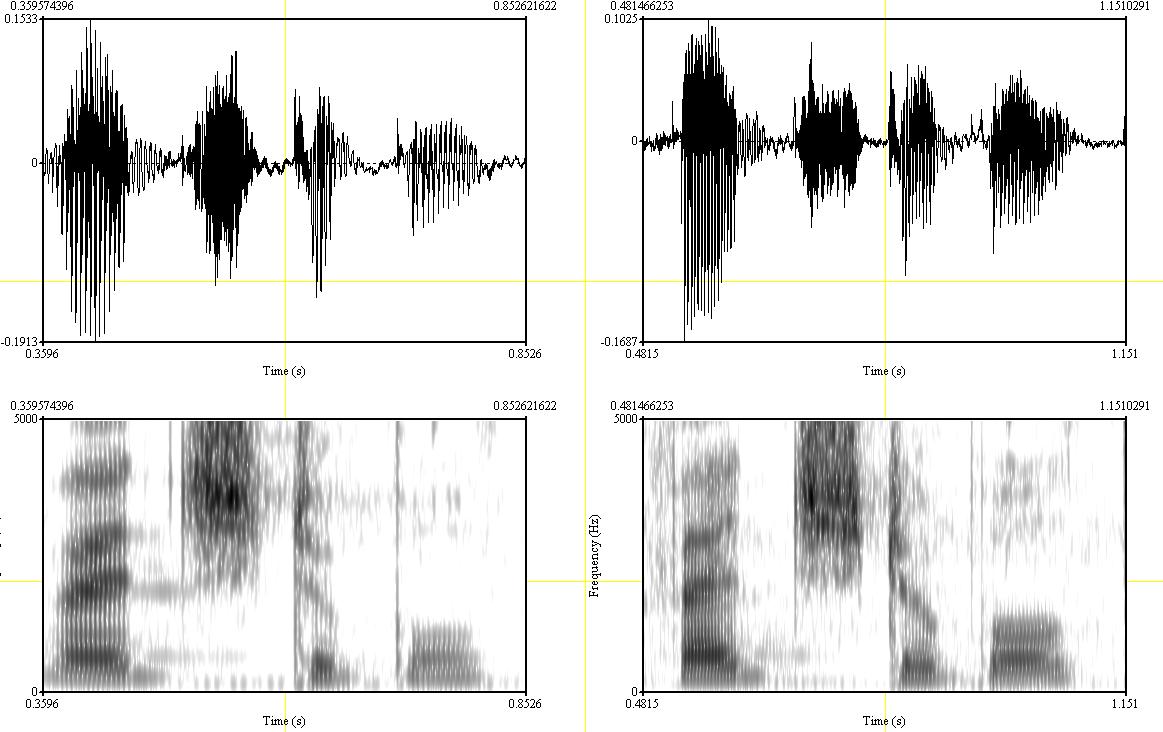
Some of you may be familiar with synesthesia, a neurological condition where you perceive sensory input from one sense as if it were another sense–with synesthesia the color yellow might taste like root beer, or the sound of a bassoon may feel like bread dough. Even without synesthesia, however, linguists (particularly phoneticians and phonologists) see sound all the time. What does it look like? Something like this:

Auuuugh what is this? It looks so boring and spiky! My eyes!

These, boys and girls and others, are what your speech sounds look like. Spectrograms are one of the most useful tools in the speech scientist’s tool shed. Heck, they’re pretty much a Swiss army shovel. You can spend your entire career basically only looking at data in this one form.

Why? Well, there’s a lot of data in a spectrogram. Big things, like whether a sound’s a ‘b’ or a ‘p’ (there’s a big black bar on the bottom if it’s a ‘b’, but not if it’s a ‘p’), but also really small things that we as humans have have a really hard time hearing. Like, remember what I said earlier about your ears lying to you? Turns out it’s a lot easier to sort out the truth if you can see what you’re hearing. Plus, by looking at spectrogram we can quantify things like average vowel frequencies really quickly and easily. (Turns out, by the way, that you can [maybe, kinda, if you squint just right and have just the right voice sample] judge how tall someone is based on their vowel frequencies.)

But spectrograms aren’t just a serious scientific tool; they’re also pretty fun. Aphex Twin, an ambient musician (I mean, he makes music in the ambient genre, not that he provide background music at canape parties. Sheesh.) uses spectrograms as an art form. This song, for example, has a picture of his face encoded in it’s spectrogram. Give it a listen and see if you can find it!

On a more general note, the study of images made with sound is known as cymatics. I’m just going to leave this video here for the more physics-minded among you:


Your ears are lying to you.

So, as a person who looks mainly at the sounds of language, I tend to put a lot of faith in my ability to hear things. And you know what? Sometimes that faith is completely misplaced. My ears lie to me, and yours do too.

Ear
Of course your butt looks great in that dress!
 Well, it’s more accurate to say that your brain lies to you. I mean, your ears are simply there to receive the speech signal, like the antennas on an old TV. You still need a tuner to translate those signals into something meaningful, and in this really over-extended metaphor, the tuner is your brain.

And, sometimes, your brain will lie to you. There’s this thing called Phonemic Restoration that’s studied extensively by Makio Kashino, among other people. Basically, what happens is that even when a speech sound is missing you’ll think you heard it. Here, try this:

Isn’t that just the freakiest thing? And it gets even better. Not only can you gain sounds that were never there to begin with at all, you can also lose sounds that should have been perfectly intelligible. I was at a conference this weekend and one of presentations, by Chris Heffner, was on how you adapt to changes in speaking rate. Basically, if you’re listening to a bit of slow speech and then encounter a segment or set of words that’s produced much faster, your brain can’t handle it very well, so it’ll just skip right over parts of it, even if it leaves you with something that’s less than grammatical.

So why does this matter? Well, first off, it’s super cool. Secondly, knowing when and how your brain lies to you can tell us more about how your brain processes language. And, really, that’s not something we know a whole lot about. Linguistics as a field is littered with unsolved problems, like rocks waiting to destroy a perfectly good tiller. By learning more about what goes on between the antenna and the television screen, though, we can keep working to solve those problems.

Flap that!

Imagine you’re walking down a sunny street in Chicago and pass by a construction site. Someone yells out, “Adam, the ladder, pick it up!” Congratulations, you’ve just found the elusive wild flap in its natural environment! And not just once, but three times.  Where was it? “Adam, the ladder, pick it up!” Try saying it aloud. If you’re a native speaker of American English, you’ll say all three of the underlined sounds the same way.

Construction worker at Westlake Center, 1988
Come on, Adam, Lulu's having to pick up your slack!

Unless you’re already pretty familiar with linguistics, you’ve probably never heard of the flap (or tap, as some linguists call it), but that doesn’t mean that you’re not already acquainted. In fact, the flap is one of most common sounds of the English language, especially American English. It’s produced by a very quick movement of the tongue against the little ridge of bone just behind your teeth. This video will give you an idea of just how quick:

It’s a little difficult to see, but did you notice that bit in the middle where the tongue suddenly jumped? That was the flap. It’s so fast that it makes the production of most other sounds seem like the proverbial tortoise. A flap takes an average of 20 milliseconds to produce; by contrast, the schwa vowel (it’s an ‘uh’ sound, the most common in the English Language) lasts an average of 64 milliseconds.  You can see why the flap is such a favorite; it’s a huge time saver.

It’s a little difficult to spot a flap  within specialized training because it doesn’t have its own letter, or make any minimal pairs. (A minimal pair is a pair of words that differ by only one sound, like “cat” and “cap”. Because you need to be able to tell the sounds apart in order to tell the words apart, you’re really good at distinguishing the sounds that make minimal pairs, at least in your native language[s]). Usually, it replaces the ‘t’ or ‘d’ sound in the middle of a word, but when you start speaking more quickly, more and more of your ‘t’s and ‘d’s end up coming out as flaps. And that makes sense. When you’re speaking more quickly, you want to be understood, but you just  don’t have as much time to articulate quickly. Since most people will hear the flap as a ‘t’ or a ‘d’, switching one for the other is just easier for everyone.

So that’s the flap, a shy, unassuming sound that you often mistake for one of its more glamorous siblings. Now that you’ve been introduced, though, try to keep an eye out for the little guy. You just might be surprised how often it pops up!