Can Animals Talk?

There’s a long-running (and I really mean long-running: Plato chimed in on this one) debate about what language is. Now, as a linguist, you’d think I’d have the inside scoop on the subject. I mean, I pretty much sit around and think about language all day, so I should have this one down cold, right?

Well, as much as I hate to admit it, not really. And it’s not just me. Ask three different linguists what language is and you’ll probably get six to twelve answers. There is one point that I’m firm on, though: language is a human phenomena. Outside of the internet and fantasy worlds (which tend to overlap a lot, now that I think about it), animals don’t talk.

You talking to me
“…and then Mildred told Randolf that she thought his new haircut made him look like a basilisk. Well, you can imagine how he took *that*.”
I’m not claiming that animals don’t make communicative noises. Far from it! As someone who has bottle-fed more than one lamb, I can tell you that there’s a definite difference between cries that indicate genuine hunger and cries that are transparent ploys to get cookies.  But there are a lot of differences between communicative behavior and language.

  1. Lying is part of language.  By lying here, I mean a wide variety of linguistic expressions that express information that is counter to the truth, including joking. Language is separate from the things it describes (there’s nothing inherently tree-ish about the word tree, for example, ditto arbor, boom and träd, though there are inherent respect points in correctly identifying all three languages) and because of this can communicate abstract thought. Abstract thought, as evinced through lying, is in inherent part of language. There’s some evidence that Koko the gorilla is capable of lying, but one isolated incident really isn’t a sound basis for scientific argument.
  2. Language is generative. I’ve written an entire post about generativity, but it’s worth repeating. Language has to have underlying structures that can be used to produce new and novel utterances. Otherwise, you’re just saying random words.
  3. Langauge is communicative. This is part of the reason why music isn’t language, though it’s completely abstract and (at least in the Western tradition) generative. Abstraction is required, but so is a connection to thoughts and ideas. Tied to this is the fact that you have to have a community to speak in, even if it’s a community of two.
  4.  Language can communicate events at a temporal distance. This is a a biggie, and one of the main reasons that I really think that Koko and other talking animals are really using language. (Quick aside: Did you know that the Nazis attempted to train talking dogs as part of the war effort? True story.) It’s pretty easy to teach a dog to bark for a treat, but try teaching it to bark because you gave it a treat two days ago. You may think that a specific bark means “treat”, but without temporal distance and repeatability, it’s pretty much just pigeons in boxes.

Now, other linguists will take other positions (or, you know, the same position ;), but this is how I see it. So what do you think: can animals talk?

Why are tongue twisters tricky? (Part 2)

Oh, so in my last post I talked about the tongue part of tongue twisters. But, as I mentioned, the really interesting part of tongue twisters comes from the brain, not the tongue. It all has to do with lexical access.

Lexical access: The process through which a speaker or listener accesses their mental lexicon (i.e. the not-so-tiny brain dictionaries we all have and are all constantly changing).

If you were a computer, your mental entries on various words would be like files you needed to access. Like, if I write “kumquat”, you probably have some sort of mental entry for it. Even if you’ve never eaten a kumquat, you’ve probably seen them, so you have that mental image associated with the words–like a .txt file with a picture in it. So, once you hear or read “kumquat”, you need to rummage around until you find that file, then open it and access the information inside. And you do! In fact, you do it very, very quickly. You do it for every single word you ever read or hearand you do it in reverse for every word you ever write or say.

Brain Surface Gyri

This is your brain on language. Well, some of the bits that deal with language, at any rate.

So lexical access is a very important process. You need it for every single aspect of language use. The good news is, there’s a lot we know about lexical access! Remember when I talked about priming? That’s an aspect of lexical access. The bad news is, there’s a whole bunch we don’t know about lexical access.

(Is lexical access starting to sound like a fake word yet? That process, by the way, is known as semantic saturation.)

This is where tongue twisters come into play. (No, I hadn’t forgotten them.) Why? Well, it turns out that tongue twisters are a really good way to get at what happens during the lexical access process. Like many things that happen in the human brain, it can be difficult to study lexical access. Unlike physicists, linguists can’t break apart the mind to see what happens and figure out what’s going on. First, it would be deeply unethical. Second, when you break a brain open, it stops working. Sometimes, however, the brain does something weird. Like with tongue twisters. If you read my previous post, you know that the tongue itself can cause problems… but not enough to explain the most common errors, like saying “How can a clam cram in a clean cream can?” as “How clan a cam cram in a clean cleam can?”

In a 1999 study, Carolyn E. Wilshire found that there were two main contributors to making tongue twisters tricky. The first factor that made it easier to confuse sounds was whether the confuseable sounds were similar. There’s lots of technical reasons this is, but basically sounds can be grouped together and some sounds are more like other sounds. “t” and “d” are really similar, for example, whereas “k” and “m” are not really that alike. Unsurprisingly, sounds that are alike are easier to confuse. Basically, you reach for something that sounds similar, then realize that you made a mistake and try to correct your error.

The second factor was that it was easier to confuse sounds that were repeated. This is because you’re more likely to “reach for” something you’ve already gotten out once, even if it’s the wrong thing. Together, these factors make for some really awesome tongue twisters. Awesome for two reasons: the first is that they’re really, really hard to say. (Try moss knife noose muff!). The second is that we can use tongue twisters like these to help increase our understanding of the human mind. And that’s what it’s really all about.

Why are tongue twisters tricky? (Part 1)

For me, the best part of the 2009 Star Trek movie was the scene where Kirk tries to pick up Uhara in a bar. After she  says he probably doesn’t know what Xenolinguistics is, he replies:

The study of alien languages. Morphology, phonology, syntax. Means you’ve got a talented tongue.

Well. Four out of five isn’t bad. Linguists know about language, not the languages themselves–so tongue talents are a skill that linguists only develop tangentially. (Although, of course, a lot of linguists do end up learning the languages they work on.) But knowing about tongues is still pretty useful. For example, it helps explain why tongue twisters are so hard.

Rolled tongue flikr
Tongue rolling is actually probably not controlled genetically. That’s right, your introductory biology textbook lied to you.
Basically, your tongue is a muscle like any other muscle, and it has certain limits. For example, there’s just a certain upper limit to how fast you can type, knit or eat, you can only produce recognizable words so fast. In addition to speed, however, there are certain motions that are difficult to make. Linguists often refer to correctly producing a given sound as “hitting an articulatory target”, and that’s a useful metaphor. For each sound in your repertoire, your tongue (and other parts of your articulatory system) have to be in certain positions.

Exercise time! Try saying “s sh s sh s sh” and “t k t k t k”. In the first, the tip of your tongue should move from that little ridge in your mouth (just behind your front teeth) to behind that ridge. In the second, the “t” sound should be made with the tip of your tongue against the roof of your mouth, and the “k” with the very back of your tongue. (I’m assuming that you have the “sh” sound in your native language, otherwise this exercise might have been a little fruitless for you. Sorry.)

You might have noticed that it was a little easier to make the “t k” sound than it was the “s sh” sound. That’s because you’re using two different parts of your tongue to make the “t k” pair, so while one is making a sound, the other is preparing to and vice versa. On the other hand, if your only using the very tip of your tongue, you have to finish one task before you can move onto the next, so your rate of making sounds is much lower. It’s the same reason that assembly lines are so much faster–you don’t have the additional time it takes to switch tasks. (BTW, that’s why, if you play a wind instrument, you can tongue faster with “t k t k” than “t t t t”.)

Ok, so we have two pressures working against your ability to produce tongue twisters. The first is that your tongue can only move so fast. You can train it to move faster, but eventually you will (barring cybernetic implants) reach the limits of the human body. Secondly, you have limited resources to make sounds, and when sounds that draw on the same resources are produced too close together, they both become more difficult to produce, and the speed at which you can produce them is reduced even further.

And that wraps it up for tongues, because the dirty secret of tongue twisters is that they’re mainly actually brain twisters. But I’ll cover that in part two. That’s right: brraaaaaaains.

Do subliminal messages (join the Illumanati) work?

Since I recently joined the Illumanati, I’ve been thinking a lot about subliminal messages.  A “subliminal stimulus” is literally something that’s below–“sub”–your perceptual limit– “liminal”. So, linguistically speaking, it would be a word that was presented to you to be read but removed before you could actually read it. Or a sound that’s too soft for you to hear.

Dollar Illuminatus
Holy crap, look at that subliminal owl! Oh wait, you see it? Well shoot. Guess it’s just a regular old liminal Illuminati owl.
So if you can’t really perceive subliminal messages, why are they even a thing?

Well, if there’s one thing I’ve learned by studying linguistics, it’s that language is complex and that there are huge gaps between what we know and what we think we know about language–at least on an individual level. (I’ve also learned that I can’t count, becuase that’s definitely two things.) We all do things that we have no idea we’re doing, and so quickly and easily that they just slip below our notice. Linguistics is all about figuring out what those things are.

One of those things is priming. Basically, when you hear or read a word it gets “warm”, like how you leave a heat signature on your sheets after you get out of bed. And if, later, you’re looking for a similar word, you’re more  likely to go back to your warm bed than another word you haven’t used lately. Of course, the effect fades over time, but it does fade very slowly. And priming effects are where you really see an effect of subliminal messages. (And, just to be clear, not really anywhere else… at least linguistically speaking. 🙂

For example, this study by Abrams, Klinger and Greewald found that, if participants had been exposed to a word earlier in their study, they were able to recognize it later when it was presented subliminally–but it only works really  well when participants had not only read the word before, but had had to think about it some by assigning it to a category. So the effect isn’t really strong enough to, say, help you lose weight or stop smoking.

The fact that it exists at all, though, does tell us something interesting about the human brain and how it uses language. For example, is our ability to interpret stimuli that are degraded tied to the pressure to understand conversational speech, even in noisy environments? What does it mean that the effect is also present with visual stimuli? Like all sciences, linguistics is all about asking the right questions, and research on subliminal stimuli opens up a whole barrel-full of questions.

Seeing noise?

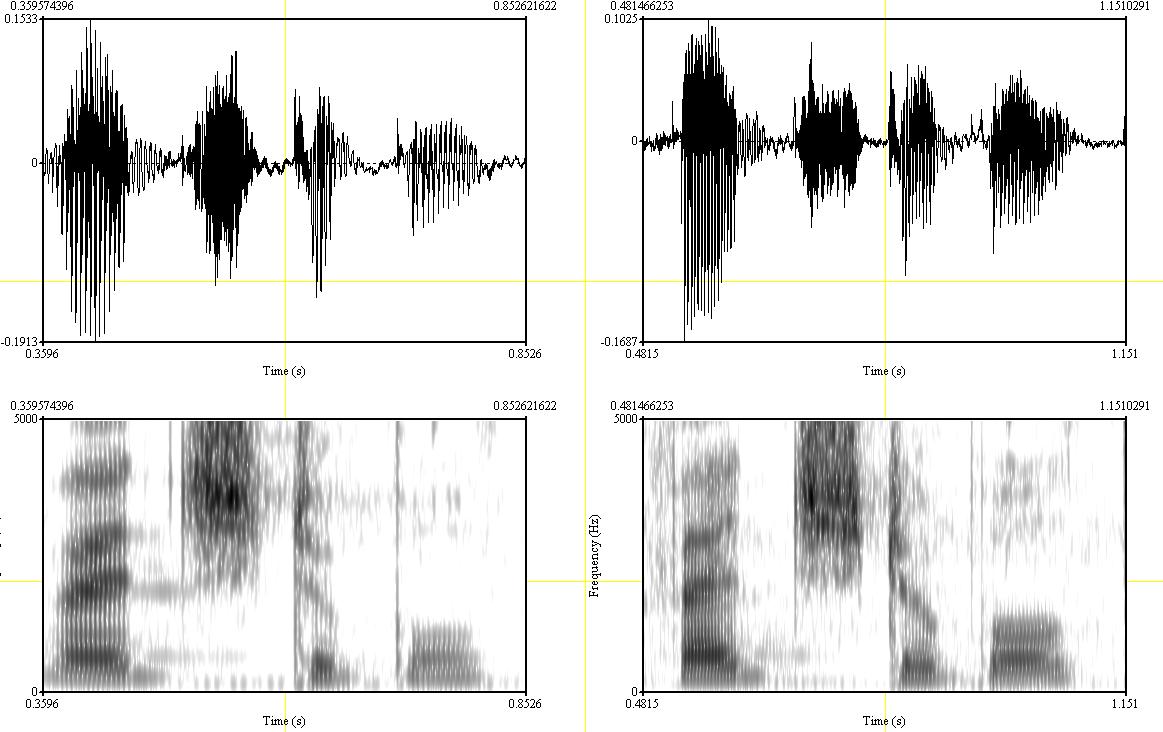
Some of you may be familiar with synesthesia, a neurological condition where you perceive sensory input from one sense as if it were another sense–with synesthesia the color yellow might taste like root beer, or the sound of a bassoon may feel like bread dough. Even without synesthesia, however, linguists (particularly phoneticians and phonologists) see sound all the time. What does it look like? Something like this:

Auuuugh what is this? It looks so boring and spiky! My eyes!

These, boys and girls and others, are what your speech sounds look like. Spectrograms are one of the most useful tools in the speech scientist’s tool shed. Heck, they’re pretty much a Swiss army shovel. You can spend your entire career basically only looking at data in this one form.

Why? Well, there’s a lot of data in a spectrogram. Big things, like whether a sound’s a ‘b’ or a ‘p’ (there’s a big black bar on the bottom if it’s a ‘b’, but not if it’s a ‘p’), but also really small things that we as humans have have a really hard time hearing. Like, remember what I said earlier about your ears lying to you? Turns out it’s a lot easier to sort out the truth if you can see what you’re hearing. Plus, by looking at spectrogram we can quantify things like average vowel frequencies really quickly and easily. (Turns out, by the way, that you can [maybe, kinda, if you squint just right and have just the right voice sample] judge how tall someone is based on their vowel frequencies.)

But spectrograms aren’t just a serious scientific tool; they’re also pretty fun. Aphex Twin, an ambient musician (I mean, he makes music in the ambient genre, not that he provide background music at canape parties. Sheesh.) uses spectrograms as an art form. This song, for example, has a picture of his face encoded in it’s spectrogram. Give it a listen and see if you can find it!

On a more general note, the study of images made with sound is known as cymatics. I’m just going to leave this video here for the more physics-minded among you:


Wug’s up?

Wait, you may be asking, what’a wug? The short answer is that a wug’s not a thing. Literally. It was chosen as a good, possible English word that didn’t have a meaning associated with it. The long answer is that a wug’s one of the ways that we know phonology is real.

These are wugs, from Jean Berko Gleason's work on child morphemic acquisition "The acquisition and dissolution of the English inflectional system", published in 1978. Sorry, nothing really funny to say about them. They are pretty cute, though.

Ok, so answer the question in the picture above. If you’re a native speaker of English, you probably said something like “There are two wugz.” Of course, you would write it “wugs”, but you’d say it with a final ‘z’. I’ve talked about this before, but it’s worth repeating:

In English, there are two ways to make a word plural. You can add -z to the end, and you can add -s to the end. They’re actually very similar sounds, but with a slight difference. When you’re making a -s sound, you don’t vibrate your vocal folds, so there’s no sort of louder buzzing noise (linguists call that voicing), but when you make a -z sound, you do voice it. When that happens is determined by the sound in front of the plural marking. If it’s voiced, the voicing is sort of smeared over into  the -s on the end, mainly because it’s easier to say.

Now, this is a rule that you know and  can apply without even thinking about it. But children have to learn it somehow, and we didn’t really know when this happened developmentally. Which is what the wug test was designed to find out. If children have learned the rule, then they’ll say “wug-z” instead of “wug-s”. It turns out that four- and five-year-olds have usually got this rule down cold. Which tells us something useful about how we acquire language. And, you know, watching four-year-olds trying to stay on task is adorable.

And, as a special bonus, here’s a video interview with Jean Berko Gleason. She’s super awesome and a real live linguist. 🙂

Your ears are lying to you.

So, as a person who looks mainly at the sounds of language, I tend to put a lot of faith in my ability to hear things. And you know what? Sometimes that faith is completely misplaced. My ears lie to me, and yours do too.

Ear
Of course your butt looks great in that dress!
 Well, it’s more accurate to say that your brain lies to you. I mean, your ears are simply there to receive the speech signal, like the antennas on an old TV. You still need a tuner to translate those signals into something meaningful, and in this really over-extended metaphor, the tuner is your brain.

And, sometimes, your brain will lie to you. There’s this thing called Phonemic Restoration that’s studied extensively by Makio Kashino, among other people. Basically, what happens is that even when a speech sound is missing you’ll think you heard it. Here, try this:

Isn’t that just the freakiest thing? And it gets even better. Not only can you gain sounds that were never there to begin with at all, you can also lose sounds that should have been perfectly intelligible. I was at a conference this weekend and one of presentations, by Chris Heffner, was on how you adapt to changes in speaking rate. Basically, if you’re listening to a bit of slow speech and then encounter a segment or set of words that’s produced much faster, your brain can’t handle it very well, so it’ll just skip right over parts of it, even if it leaves you with something that’s less than grammatical.

So why does this matter? Well, first off, it’s super cool. Secondly, knowing when and how your brain lies to you can tell us more about how your brain processes language. And, really, that’s not something we know a whole lot about. Linguistics as a field is littered with unsolved problems, like rocks waiting to destroy a perfectly good tiller. By learning more about what goes on between the antenna and the television screen, though, we can keep working to solve those problems.

Flap that!

Imagine you’re walking down a sunny street in Chicago and pass by a construction site. Someone yells out, “Adam, the ladder, pick it up!” Congratulations, you’ve just found the elusive wild flap in its natural environment! And not just once, but three times.  Where was it? “Adam, the ladder, pick it up!” Try saying it aloud. If you’re a native speaker of American English, you’ll say all three of the underlined sounds the same way.

Construction worker at Westlake Center, 1988
Come on, Adam, Lulu's having to pick up your slack!

Unless you’re already pretty familiar with linguistics, you’ve probably never heard of the flap (or tap, as some linguists call it), but that doesn’t mean that you’re not already acquainted. In fact, the flap is one of most common sounds of the English language, especially American English. It’s produced by a very quick movement of the tongue against the little ridge of bone just behind your teeth. This video will give you an idea of just how quick:

It’s a little difficult to see, but did you notice that bit in the middle where the tongue suddenly jumped? That was the flap. It’s so fast that it makes the production of most other sounds seem like the proverbial tortoise. A flap takes an average of 20 milliseconds to produce; by contrast, the schwa vowel (it’s an ‘uh’ sound, the most common in the English Language) lasts an average of 64 milliseconds.  You can see why the flap is such a favorite; it’s a huge time saver.

It’s a little difficult to spot a flap  within specialized training because it doesn’t have its own letter, or make any minimal pairs. (A minimal pair is a pair of words that differ by only one sound, like “cat” and “cap”. Because you need to be able to tell the sounds apart in order to tell the words apart, you’re really good at distinguishing the sounds that make minimal pairs, at least in your native language[s]). Usually, it replaces the ‘t’ or ‘d’ sound in the middle of a word, but when you start speaking more quickly, more and more of your ‘t’s and ‘d’s end up coming out as flaps. And that makes sense. When you’re speaking more quickly, you want to be understood, but you just  don’t have as much time to articulate quickly. Since most people will hear the flap as a ‘t’ or a ‘d’, switching one for the other is just easier for everyone.

So that’s the flap, a shy, unassuming sound that you often mistake for one of its more glamorous siblings. Now that you’ve been introduced, though, try to keep an eye out for the little guy. You just might be surprised how often it pops up!

What words are easy to say?

Ok, so in the last couple posts I’ve been throwing around terms like “easy to say” without giving a whole lot of explanation. And that’s a pity, because the study of what words are “easy” and what words are “hard” is, in my opinion, one of the greatest sub-disciplines in linguistics: phonotactics.

Imperial Russian soldier with phone
No, that's phone tactics, not phonotactics. They're completely different.
Phonotactics is like your great-aunt who always arranges the seating at family reunions becuase she remembers who fought with whom twenty years ago and knows not to sit them together. Basically, some sounds really like to be next to others. Like vowels. Vowels like to be next to everyone. In Japanese, for example, with a couple of exceptions, most syllables have to be made of a consonant plus a vowel. (In ling speak, this is known as “CV”. C for consonant, V for vowel. Yeah, unlike physicists, we like to keep things simple.) What’s even more amazing is that within six months of birth, Japanese infants prefer sounds that are CVCV to those that are CVCCV or CVCVC.

Polish, on the other hand, notoriously plays fast and loose with syllable structure. You can have consonant clusters up to five sounds long in Polish that, most weirdly, don’t follow the same sorts of rules that other languages do. Like English. English can have pretty big consonant clusters… but they’ll only get really big if the first or last sound in the word is ‘s’. (Protip: That’s why ‘s’ is such a great letter in scrabble; there’s a bunch of things you can slap it on to piggyback of someone else’s word, even outside of its morpheme status.) If you’ve ever stumbled over a Polish last name, there’s a sound linguistic reason you found it hard.

Why is this useful? Well, besides its obvious use in language teaching and being great cocktail party conversation material,  if you want to make a plausibly difficult-to-pronounce alien language, screw up your phonotactics and you’ll leave audio book readers in tears.

Laziness vs. Niceness

So, I like to say that there are two forces at work in linguistics change: laziness and niceness. Well, that’s a little vague. When I say linguistic change, I really mean phonological change. Phonological change is whenever one sound or set of sounds is replaced by another, and it happens all the time.

1544 Championship 40
The guy with his legs in the air is laziness, the guy bending over backwards is niceness and the stamp is, uh, your mouth.
Let’s take an example. How about the glottal stop in English? Here, read this and then come back. I’ll wait.

We splash glottal stops around in our speech because they’re easy and quick to say. So that’s laziness; it doesn’t hurt anyone, it just makes the speaker’s life a little easier. But wait! Let’s say that you move to Egypt and start using Egyptian Arabic. In fact, let’s say that a whole bunch of English speakers move to Egypt, so many that there starts to be a really large native English speaker population in Cairo… but a population that still has to learn and use Egyptian Arabic just to get around during the day.

Now, in Egyptian Arabic, if you slosh glottal stops around like mop water on a dirty floor, you’re going to run into problems. Why? Because the glottal stop is a separate sound. It would be like if I used “b” and “p” interchangeably. There’s a big different between “Hand me the robe” and “Hand me the rope” (particularly if you’re a cultist). It’s confusing. And confusing people isn’t nice.

So, if you’re nice, you’ll use glottal stops only when you’re supposed to in English and Arabic, and use the other sounds where they belong. The downside? It’s more work for a speaker to make a full k-sound than just a glottal stop.

So you’ve got this tension between laziness and niceness, and in different languages and different situations, a different pressure will win out. Or,  you know, at least be something that you worry about more.